Determine all composite integers that satisfy the following property: if are all the positive divisors of with , then divides for every .
International Mathematical Olympiad 2023
Documents
| Year | Filename | Language | Source |
|---|---|---|---|
| 2023 | IMO-2023-problems-eng.pdf | en | — |
Let be an acute-angled triangle with . Let be the circumcircle of . Let be the midpoint of the arc of containing . The perpendicular from to meets at and meets again at . The line through parallel to meets line at . Denote the circumcircle of triangle by . Let meet again at . Prove that the line tangent to at meets line on the internal angle bisector of .
For each integer , determine all infinite sequences of positive integers for which there exists a polynomial of the form , where are non-negative integers, such that
for every integer .
Let be pairwise different positive real numbers such that
is an integer for every . Prove that .
Let be a positive integer. A Japanese triangle consists of circles arranged in an equilateral triangular shape such that for each , the row contains exactly circles, exactly one of which is coloured red. A ninja path in a Japanese triangle is a sequence of circles obtained by starting in the top row, then repeatedly going from a circle to one of the two circles immediately below it and finishing in the bottom row. Here is an example of a Japanese triangle with , along with a ninja path in that triangle containing two red circles.
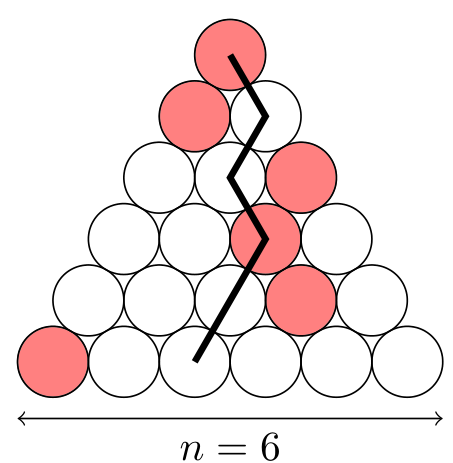
In terms of , find the greatest such that in each Japanese triangle there is a ninja path containing at least red circles.
Let be an equilateral triangle. Let be interior points of such that , , , and
Let and meet at , let and meet at , and let and meet at . Prove that if triangle is scalene, then the three circumcircles of triangles , and all pass through two common points.
(Note: a scalene triangle is one where no two sides have equal length.)