Find all surjective functions such that for all positive integers and , exactly one of the following equations is true:
Remarks: denotes the set of all positive integers. A function is said to be surjective if for every there exists such that .
| Year | Filename | Language | Source |
|---|---|---|---|
| 2015 | MEMO_2015_I_T_en.pdf | en | http://memo2015.dmfa.si/problems.html |
Find all surjective functions such that for all positive integers and , exactly one of the following equations is true:
Remarks: denotes the set of all positive integers. A function is said to be surjective if for every there exists such that .
Let be an integer. An inner diagonal of a simple -gon is a diagonal that is contained in the -gon. Denote by the number of all inner diagonals of a simple -gon and by the least possible value of , where is a simple -gon. Prove that no two inner diagonals of intersect (except possibly at a common endpoint) if and only if .
Remark: A simple -gon is a non-self-intersecting polygon with vertices. A polygon is not necessarily convex.
Let be a cyclic quadrilateral. Let be the intersection of lines parallel to and passing through points and , respectively. The lines and intersect the circumcircle of again at and , respectively. Prove that points , , , and lie on a circle.
Find all pairs of positive integers for which there exist relatively prime integers and greater than such that is an integer.
Prove that for all positive real numbers , , such that the following inequality holds:
Determine all functions such that holds for all nonzero real numbers and .
There are students standing in line in positions to . While the teacher looks away, some students change their positions. When the teacher looks back, they are standing in line again. If a student who was initially in position is now in position , we say the student moved for steps. Determine the maximal sum of steps of all students that they can achieve.
Let be a positive integer. In each of the unit squares of an board, one of the two diagonals is drawn. The drawn diagonals divide the board into regions. For each , determine the smallest and the largest possible values of .
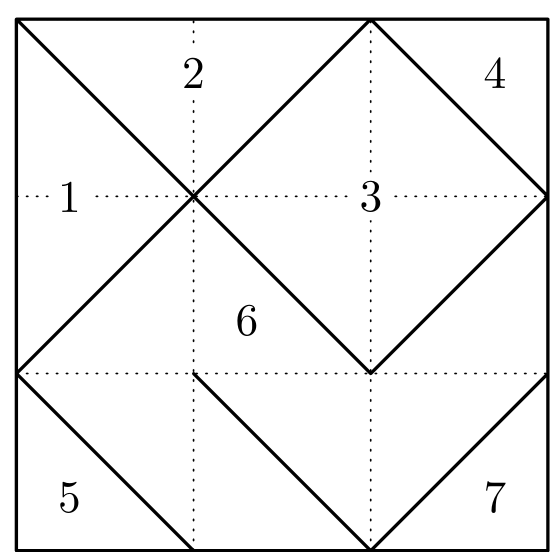
Example with ,
Let be an acute triangle with . Prove that there exists a point with the following property: whenever two distinct points and lie in the interior of such that the points , , , and lie on a circle and holds, the line passes through .
Let be the incentre of triangle with and let the line intersect the side at . Suppose that point lies on the segment and satisfies . Further, let be the point obtained by reflecting over the perpendicular bisector of , and let be the other intersection of the circumcircles of the triangles and . Prove that .
Find all pairs of positive integers such that
Let be an integer. Determine the number of positive integers such that and is divisible by .