Let denote the set of all positive rational numbers and let . Determine all functions satisfying
Let denote the set of all positive rational numbers and let . Determine all functions satisfying
The two figures depicted below consisting of and unit squares, respectively, are called staircases.
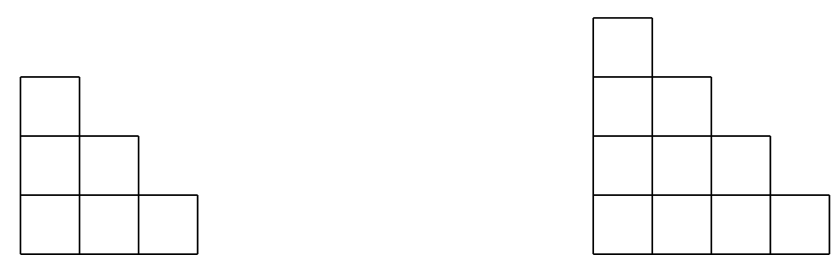
Consider a board consisting of cells, each being a unit square. Two arbitrary cells were removed from the same row of the board. Prove that the rest of the board cannot be cut (along the cell borders) into staircases (possibly rotated).
Let be an acute-angled triangle with , and let be the foot of its altitude from . Let and be the centroids of the triangles and , respectively. Let be a point on the line segment such that and the points and are concyclic. Prove that the lines and are concurrent.
(a) Prove that for every positive integer there exists an integer such that
(b) Denote by the smallest integer such that the equation (*) holds. Prove that .
Remark: For a real number , we denote by the largest integer not larger than .
Let , and be positive real numbers satisfying . Prove that
Let be a polynomial of degree with rational coefficients such that has pairwise different real roots forming an arithmetic progression. Prove that among the roots of there are two that are also the roots of some polynomial of degree with rational coefficients.
A group of pirates had an argument and now each of them holds some other two at gunpoint. All the pirates are called one by one in some order. If the called pirate is still alive, he shoots both pirates he is aiming at (some of whom might already be dead). All shots are immediately lethal. After all the pirates have been called, it turns out that exactly pirates got killed.
Prove that if the pirates were called in whatever other order, at least pirates would have been killed anyway.
Let be a positive integer and be positive integers not larger than , for some integer . A representation of a non-negative integer is a sequence of non-negative integers such that
Prove that if a non-negative integer has a representation, then it also has a representation where less than of the numbers are non-zero.
Let be an acute-angled triangle with , and let be the foot of its altitude from . Points and lie on the rays and , respectively, so that points , and are collinear and points , , and lie on one circle with center . Prove that if is the midpoint of and is the orthocenter of , then is a parallelogram.
Let be a triangle. The internal bisector of intersects the side at and the circumcircle of triangle again at . Let be the perpendicular projection of onto . The circumcircle of triangle intersects line again at . Lines and meet at point . Prove that .
Let be the sequence of positive integers such that
Prove that for every prime number of the form , where is a non-negative integer, there exists a positive integer such that is divisible by .
An integer is called Silesian if there exist positive integers , and such that
(a) Prove that there are infinitely many Silesian integers.
(b) Prove that not every positive integer is Silesian.