Documents

YearFilenameLanguage
2025MEMO_2025_I_en.pdfen
2025MEMO_2025_T_en.pdfen
Problem I-1

Let R+\mathbb{R}^+ be the set of positive real numbers. Let f ⁣:R+R+f\colon \mathbb{R}^{+}\to \mathbb{R}^{+} be a function such that for all x,yR+x,y\in \mathbb{R}^{+} it holds that

yf2025(x)xf(y).y f^{2025}(x) \geq x f(y).

Show that there exists a positive integer n0n_0 such that for all positive integers nn0n \geq n_0 and for all xR+x \in \mathbb{R}^+ it holds that

fn(x)x.f^n(x) \geq x.

Remark. Here fnf^n denotes the function ff applied nn times, this means fn(x)=f(f(f(x)))n timesf^n(x) = \underbrace{f(f(\ldots f(x)\ldots))}_{n \text{ times}}.

Problem I-2

On an infinite square grid, on which some unit squares are coloured red, a ruby rook is a piece which, in one move, can travel any number of squares in one direction parallel to one of the grid lines (either vertically or horizontally), while remaining on red squares at all times throughout the move.

Starting with an uncoloured infinite square grid, Alice performs the following procedure: First, she colours at most 2025 of the unit squares red. Afterwards, she places some ruby rooks on distinct red unit squares, such that the following two rules are satisfied:

  • No ruby rook can reach another ruby rook in one move.
  • Every ruby rook can reach every other ruby rook in two moves.

Find the maximum possible number of ruby rooks that Alice can place during this procedure.

Problem I-3

Let ABCABC be a triangle. Its incircle ω\omega touches the sides BC,CABC, CA and ABAB at points D,ED, E and FF, respectively. Let PP and QQ be points on the line BCBC distinct from DD such that PB=BDPB = BD and QC=CDQC = CD. Prove that the circumcircles of the triangles PCEPCE and QBFQBF and the circle ω\omega pass through a common point.

Problem I-4

A subset SS of the integers is called Saxonian if for every three pairwise different elements a,b,cSa, b, c \in S the number ab+cab + c is the square of an integer. Prove that any Saxonian set is finite. Determine the largest possible number of elements that a Saxonian set can have.

Problem T-1

Bob has nn coins with integer values c1c2cn>0.c_1 \geq c_2 \geq \cdots \geq c_n > 0.

He is standing in front of a vending machine that offers nn candy bars with positive integer costs b1,b2,,bnb_1, b_2, \ldots, b_n. Bob notices that for every i{1,,n}i \in \{1, \ldots, n\}, it holds that b1+b2++bic1+c2++ci.b_1 + b_2 + \cdots + b_i \geq c_1 + c_2 + \cdots + c_i.

Furthermore, the total value of Bob's coins equals the sum of the costs of all the candy bars. The candy bars can be purchased in any order. In order to buy the ii-th candy bar, Bob has to insert coins of total value at least bib_i. However, the machine does not give him back any change.

Prove that Bob can buy at least half of the candy bars.
Problem T-2

Let R+\mathbb{R}^+ be the set of positive real numbers. Determine all functions f ⁣:R+R+f\colon \mathbb{R}^{+}\to \mathbb{R}^{+} such that for all numbers x,yR+x,y\in \mathbb{R}^{+}, we have f(xy)+f(x)=f(y)f(xf(y))+f(x)f(y),f(xy) + f(x) = f(y)f(xf(y)) + f(x)f(y),

and there exists at most one number aR+a \in \mathbb{R}^+ such that f(a)=1f(a) = 1.

Problem T-3

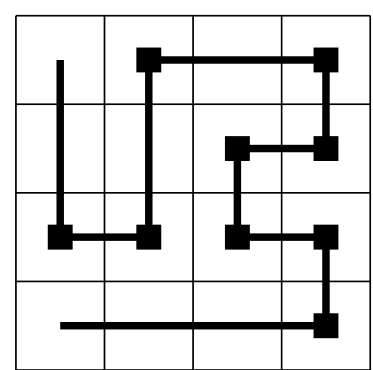
A snake in an n×nn \times n grid is a path composed of straight line segments between centres of adjacent cells, going through the centres of all the n2n^2 grid cells, which visits each cell exactly once. Here two grid cells are considered to be adjacent if they share an edge. Note that all pieces of the snake path are parallel to grid lines. The figure shows an example of a snake in a 4×44 \times 4 grid. This snake makes nine 9090^\circ turns, marked by small black squares.

figure

Let us now consider a snake through the 2025 cells of a 45×4545 \times 45 grid. What is the maximum possible number of 9090^\circ turns that such a snake can make?

Problem T-4

Let nn be a positive integer. In the province of Laplandia there are 100n100n cities, each two connected by a direct road, and each of these roads has a toll station collecting a positive amount of toll revenue. For each road, the revenue of its toll station is split equally between the two cities at the ends of the road (meaning that each of the two cities receives half of the income). For each city, the total toll revenue is given by the sum of the revenues it receives from the 100n1100n - 1 toll stations on its roads.

According to a new law, the revenues of some of the toll stations will be collected by the federal government instead of by the adjacent cities. The governor of Laplandia is allowed to choose those toll stations. The mayors of the cities demand that for each city, the sum of the remaining revenues it receives from the other toll stations after this change is at least 99%99\% of its former total toll revenue.

Find the largest positive integer kk, depending on nn, such that the governor can always choose kk toll stations for the federal government to collect the toll revenue, while satisfying the demand of the city mayors.

Problem T-5

Let ABCABC be an acute triangle with AB<ACAB < AC. Denote by DD the foot of the perpendicular from AA to BCBC. Let EE be the point such that ABECABEC is a parallelogram. Let MM be a point inside triangle ABCABC such that MB=MCMB = MC. Let FF be the reflection of point DD across the tangent to the circumcircle of triangle ADMADM at point MM. Prove that AF=DEAF = DE.

Problem T-6

Let ABCABC be an acute triangle with an interior point DD such that BDC=180BAC\angle BDC = 180^{\circ} - \angle BAC. The lines BDBD and ACAC intersect at the point EE, and the lines CDCD and ABAB intersect at the point FF. The points PEP \neq E and QFQ \neq F lie on the line EFEF so that BP=BEBP = BE and CQ=CFCQ = CF. Assume that the segments APAP and AQAQ intersect the circumcircle ω\omega of ABCABC at the points RAR \neq A and SAS \neq A, respectively. Prove that the lines RFRF and SESE intersect on ω\omega.

Problem T-7

Let nn be a positive integer such that the sum of positive divisors of n2+n+1n^2 + n + 1 is divisible by 3. Prove that it is possible to partition the set of positive divisors of n2+n+1n^2 + n + 1 into three sets such that the product of all elements in each set is the same.

Problem T-8

Determine whether the following statement is true for every polynomial PP of degree at least 2 with nonnegative integer coefficients:

There exists a positive integer mm such that for infinitely many positive integers nn the number Pn(m)P^n(m) has more than nn distinct positive divisors.

Remark. Here PnP^n denotes PP applied nn times, this means Pn(x)=P(P(P(x)))n timesP^n(x) = \underbrace{P(P(\ldots P(x)\ldots))}_{n \text{ times}}.