Find all surjective functions such that for all positive integers and , exactly one of the following equations is true:
Remarks: denotes the set of all positive integers. A function is said to be surjective if for every there exists such that .
| Year | I-1 | I-2 | I-3 | I-4 | T-1 | T-2 | T-3 | T-4 | T-5 | T-6 | T-7 | T-8 | Solved |
|---|---|---|---|---|---|---|---|---|---|---|---|---|---|
| 2025 | 0/12 | ||||||||||||
| 2024 | 0/12 | ||||||||||||
| 2023 | 0/12 | ||||||||||||
| 2022 | 0/12 | ||||||||||||
| 2021 | 0/12 | ||||||||||||
| 2020 | 0/4 | ||||||||||||
| 2019 | 0/12 | ||||||||||||
| 2018 | 0/12 | ||||||||||||
| 2016 | 0/12 | ||||||||||||
| 2015 | 0/12 | ||||||||||||
| 2013 | 0/12 | ||||||||||||
| 2011 | 0/12 | ||||||||||||
| 2010 | 0/12 | ||||||||||||
| 2009 | 0/12 |
Find all surjective functions such that for all positive integers and , exactly one of the following equations is true:
Remarks: denotes the set of all positive integers. A function is said to be surjective if for every there exists such that .
Let be an integer. An inner diagonal of a simple -gon is a diagonal that is contained in the -gon. Denote by the number of all inner diagonals of a simple -gon and by the least possible value of , where is a simple -gon. Prove that no two inner diagonals of intersect (except possibly at a common endpoint) if and only if .
Remark: A simple -gon is a non-self-intersecting polygon with vertices. A polygon is not necessarily convex.
Let be a cyclic quadrilateral. Let be the intersection of lines parallel to and passing through points and , respectively. The lines and intersect the circumcircle of again at and , respectively. Prove that points , , , and lie on a circle.
Find all pairs of positive integers for which there exist relatively prime integers and greater than such that is an integer.
Prove that for all positive real numbers , , such that the following inequality holds:
Determine all functions such that holds for all nonzero real numbers and .
There are students standing in line in positions to . While the teacher looks away, some students change their positions. When the teacher looks back, they are standing in line again. If a student who was initially in position is now in position , we say the student moved for steps. Determine the maximal sum of steps of all students that they can achieve.
Let be a positive integer. In each of the unit squares of an board, one of the two diagonals is drawn. The drawn diagonals divide the board into regions. For each , determine the smallest and the largest possible values of .
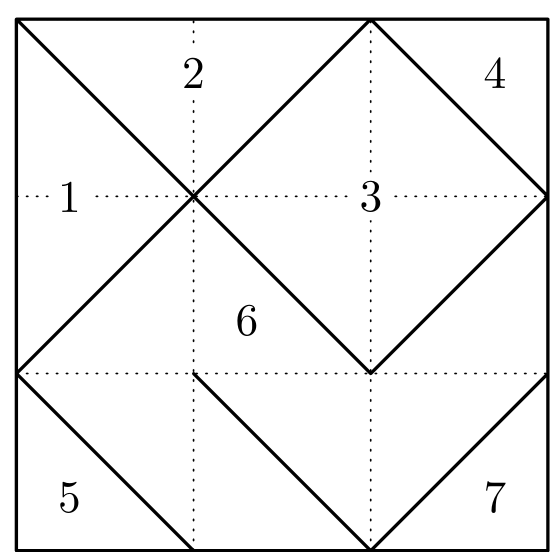
Example with ,
Let be an acute triangle with . Prove that there exists a point with the following property: whenever two distinct points and lie in the interior of such that the points , , , and lie on a circle and holds, the line passes through .
Let be the incentre of triangle with and let the line intersect the side at . Suppose that point lies on the segment and satisfies . Further, let be the point obtained by reflecting over the perpendicular bisector of , and let be the other intersection of the circumcircles of the triangles and . Prove that .
Find all pairs of positive integers such that
Let be an integer. Determine the number of positive integers such that and is divisible by .
Let be positive real numbers such that
Prove that
Find all triples for which equality holds.
Let be a positive integer. On a board consisting of squares, exactly tokens are placed so that each row and each column contains one token. In a step, a token is moved horizontally or vertically to a neighbouring square. Several tokens may occupy the same square at the same time. The tokens are to be moved to occupy all the squares of one of the two diagonals.
Determine the smallest number such that for any initial situation, we can do it in at most steps.
Let be an isosceles triangle with . Let be a point inside the triangle such that . Let be the intersection of the line and the line parallel to that passes through . Let be the intersection of the angle bisectors of the angles and .
Show that the lines and are perpendicular.
Let and be positive integers. Prove that there exist positive integers and such that
Find all functions such that for all , .
Let , , , such that , , and . Prove the inequality
There are houses on the northern side of a street. Going from the west to the east, the houses are numbered from to . The number of each house is shown on a plate. One day the inhabitants of the street make fun of the postman by shuffling their number plates in the following way: for each pair of neighbouring houses, the current number plates are swapped exactly once during the day.
How many different sequences of number plates are possible at the end of the day?
Consider finitely many points in the plane with no three points on a line. All these points can be coloured red or green such that any triangle with vertices of the same colour contains at least one point of the other colour in its interior.
What is the maximal possible number of points with this property?
Let be an acute triangle. Construct a triangle such that , , , and the lines , , and pass through the points , , and , respectively. (All six points , , , , , and are distinct.)
Let be a point inside an acute triangle , such that is a common tangent of the circumcircles of and . Let be the intersection of the lines and , and let be the intersection of the lines and . Let be the intersection of the line and the perpendicular bisector of the segment . The circumcircle of and the circle with centre and radius intersect at points and .
Prove that the segment is a diameter of .
The numbers from to are written row by row into a table consisting of cells. Afterwards, all columns and all rows containing at least one of the perfect squares are simultaneously deleted.
How many cells remain?
The expression is written on the blackboard. Two players, and , play a game, taking turns. Player takes the first turn. In each turn, the player on turn replaces a symbol by a positive integer. After all the symbols are replaced, player replaces each of the signs by either or , independently of each other. Player wins if the value of the expression on the blackboard is not divisible by any of the numbers . Otherwise, player wins.
Determine which player has a winning strategy.
Initially, only the integer is written on a board. An integer on the board can be replaced with four pairwise different integers such that the arithmetic mean of the four new integers is equal to the number . In a step we simultaneously replace all the integers on the board in the above way. After steps we end up with integers on the board. Prove that
Let be an integer. John and Mary play the following game: First John labels the sides of a regular -gon with the numbers in whatever order he wants, using each number exactly once. Then Mary divides this -gon into triangles by drawing diagonals which do not intersect each other inside the -gon. All these diagonals are labeled with number . Into each of the triangles the product of the numbers on its sides is written. Let be the sum of those products.
Determine the value of if Mary wants the number to be as small as possible and John wants to be as large as possible and if they both make the best possible choices.
In a plane the circles and with centers and , respectively, intersect in two points and . Assume that is obtuse. The tangent to in intersects again in and the tangent to in intersects again in . Let be the circumcircle of the triangle . Let be the midpoint of that arc of that contains . The lines and intersect again in and , respectively. Prove that the line is perpendicular to .
Let and , with , be positive integers such that the number is divisible by . Prove that .
Find all functions such that the equality holds for all , where is the set of real numbers.
Let be positive real numbers such that Prove that
For an integer , let be the set of points in the plane. ( is the set of integers.)
What is the maximum possible number of points in a subset which does not contain three distinct points being the vertices of a right triangle?
Let be an integer. At a MEMO-like competition, there are participants, there are languages spoken, and each participant speaks exactly three different languages.
Prove that at least of the spoken languages can be chosen in such a way that no participant speaks more than two of the chosen languages.
( is the smallest integer which is greater than or equal to .)
Let be a convex pentagon with all five sides equal in length. The diagonals and meet in with . Prove that has a pair of parallel sides.
Let be an acute triangle. Denote by and the feet of the altitudes from vertices and , respectively. Let be a point inside the triangle such that the line is tangent to the circumcircle of the triangle and the line is tangent to the circumcircle of the triangle . Show that the line is perpendicular to .
Let and be disjoint nonempty sets with . Show that there exist elements and such that the number is divisible by .
We call a positive integer amazing if there exist positive integers such that the equality holds. Prove that there exist consecutive positive integers which are amazing.
(By we denote the greatest common divisor of positive integers and .)
Find all functions such that for all , we have
All positive divisors of a positive integer are written on a blackboard. Two players and play the following game taking alternate moves. In the first move, the player erases . If the last erased number is , then the next player erases either a divisor of or a multiple of . The player who cannot make a move loses. Determine all numbers for which can win independently of the moves of .
We are given a cyclic quadrilateral with a point on the diagonal such that and . Let be the center of the circumcircle of the triangle . The circle intersects the line in the points and . Prove that the lines , , and meet at one point.
Find all positive integers which satisfy the following two conditions:
(i) has at least four different positive divisors;
(ii) for any divisors and of satisfying , the number divides .
Three strictly increasing sequences of positive integers are given. Every positive integer belongs to exactly one of the three sequences. For every positive integer , the following conditions hold:
(i) ;
(ii) ;
(iii) the number is even.
Find , , and .
For each integer , determine the largest real constant such that for all positive real numbers , we have
In each vertex of a regular -gon there is a fortress. At the same moment each fortress shoots at one of the two nearest fortresses and hits it. The result of the shooting is the set of the hit fortresses; we do not distinguish whether a fortress was hit once or twice. Let be the number of possible results of the shooting. Prove that for every positive integer , and are relatively prime.
Let be a positive integer. A square is partitioned into unit squares. Each of them is divided into two triangles by the diagonal parallel to . Some of the vertices of the unit squares are colored red in such a way that each of these triangles contains at least one red vertex. Find the least number of red vertices.
The incircle of the triangle touches the sides , , and in the points , , and , respectively. Let be the point symmetric to with respect to the incenter. The lines and intersect at . Prove that is parallel to .
Let , , , , be points such that is a cyclic quadrilateral and is a parallelogram. The diagonals and intersect at and the rays and intersect at . Prove that .
For a nonnegative integer , define to be the positive integer with decimal representation
Prove that is always the sum of two positive perfect cubes but never the sum of two perfect squares.
We are given a positive integer which is not a power of . Show that there exists a positive integer with the following two properties:
(i) is the product of two consecutive positive integers;
(ii) the decimal representation of consists of two identical blocks of digits.
Find all functions such that
for all , where denotes the set of real numbers.
Suppose that we have distinct colours. Let be the greatest integer with the property that every side and every diagonal of a convex polygon with vertices can be coloured with one of colours in the following way:
at least two distinct colours are used, and
any three vertices of the polygon determine either three segments of the same colour or of three different colours.
Show that with equality for infinitely many values of .